A technical gap
In the 1990s, China's largest radio telescope was under 30 meters. Without independent facilities, astronomers relied on foreign data, limiting research opportunities.

UNIT 06 · A DREAM OF STARS AND SEAS
Meet FAST — the Five-hundred-meter Aperture Spherical Telescope, a giant ear on Earth listening for the faintest whispers from space.
01 / BACKGROUND

In the 1990s, China's largest radio telescope was under 30 meters. Without independent facilities, astronomers relied on foreign data, limiting research opportunities.
In 1993, an international initiative proposed a new generation of giant radio telescopes. After China's proposal was not selected for the international SKA plan, China pursued FAST independently under Nan Rendong's leadership.
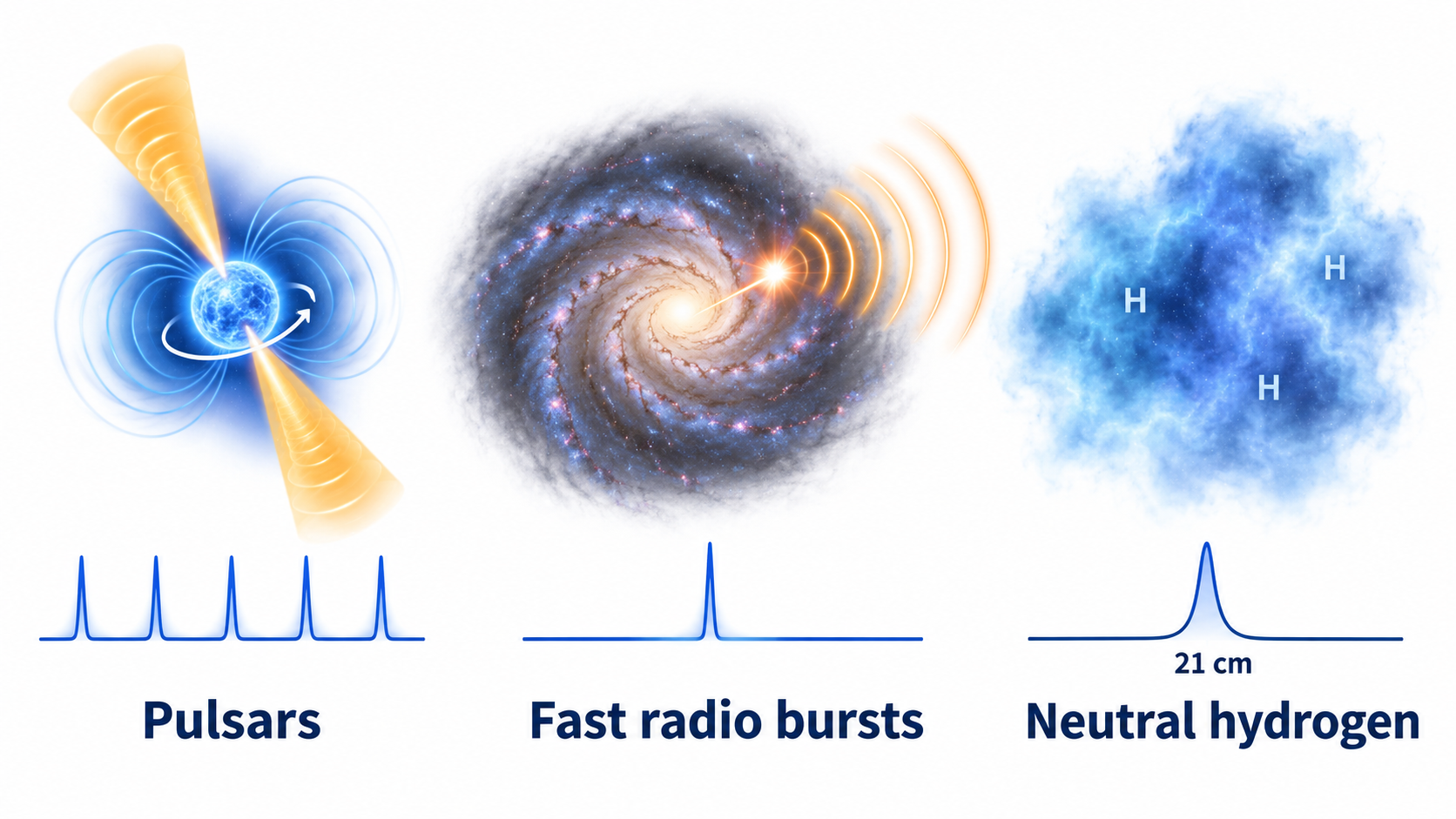
Cosmic radio signals are extremely weak, so a huge aperture is essential. FAST studies neutral hydrogen, pulsars, gravitational waves, fast radio bursts, and possible signs of extraterrestrial intelligence.
FAST drove advances in steel cables, the active reflector, and feed-support systems—helping China's radio astronomy move from catching up toward the front rank.
02 / HOW IT WORKS
FAST does more than collect radio waves. Its active surface and moving receiver work together to keep extremely weak signals in focus.
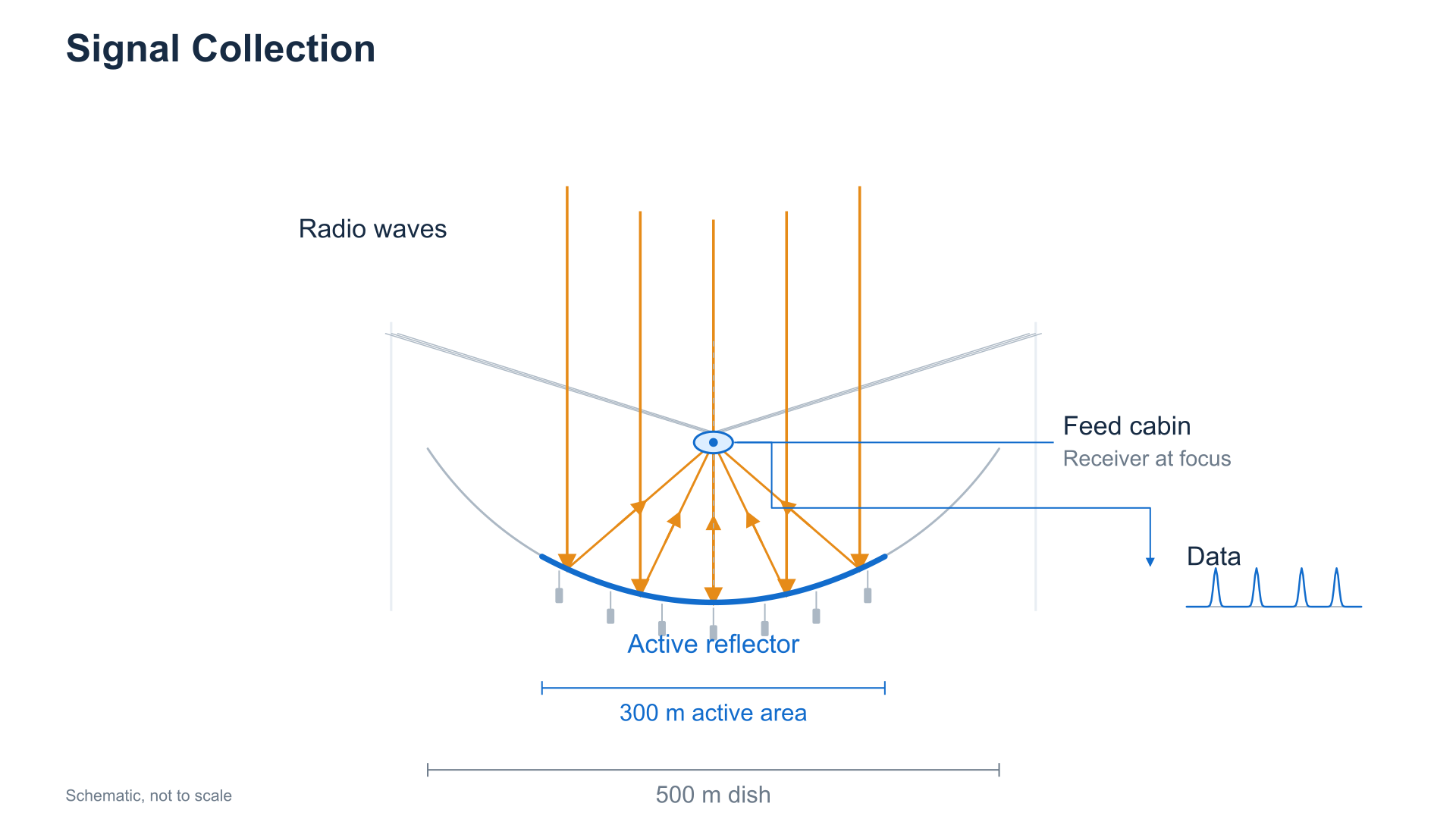
Incoming radio waves → active parabolic area → receiver → digital data
FAST's reflector is 500 meters across. During an observation, a section about 300 meters across is reshaped into a parabolic surface.
The active surface reflects radio waves toward one focal point. A receiver in the suspended feed cabin collects the focused signals.
Electronic equipment amplifies the weak signals and converts them into digital data for computers and scientists to analyze.
The key idea
Gather radio waves over a huge area and bring them together at the receiver.
ACTIVE REFLECTOR / TARGET TRACKING
As Earth rotates, a target appears to move across the sky. FAST adjusts different parts of its cable-supported reflector, while six cables move the feed cabin to keep the receiver at the focal point.
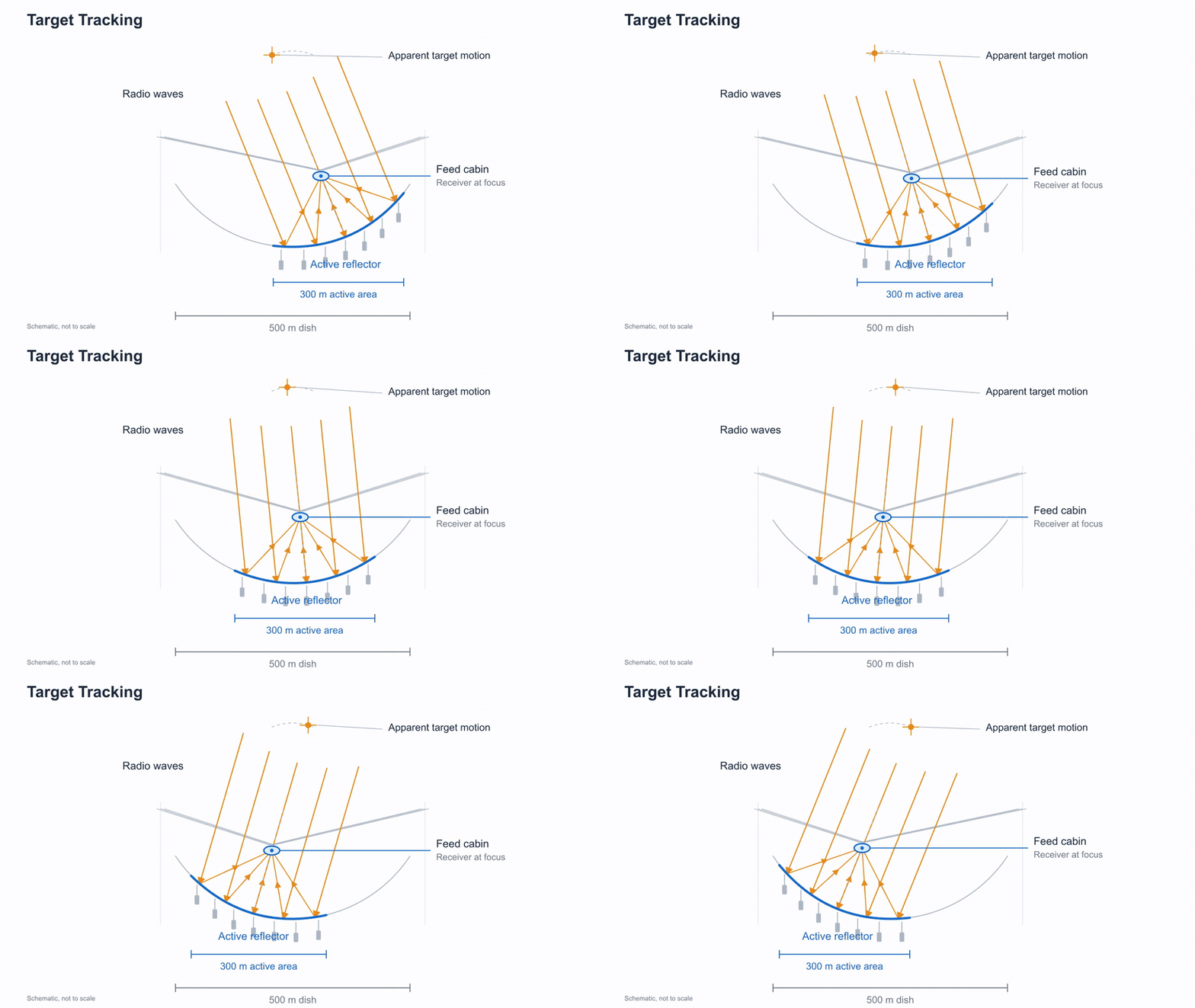
Conceptual animation · the active area and feed cabin adjust together
WHAT CAN FAST OBSERVE?
03 / SIGNIFICANCE
Thanks to its high sensitivity, FAST has spotted numerous pulsars. It opens new windows for humans to study the deep universe.
This giant telescope is a home-grown project. It overcomes plenty of technical bottlenecks in radio astronomy equipment.
FAST pushes forward the development of China's basic science. It helps our country step into the front rank of astronomical research.
Rather than serving only one country, FAST provides open resources for researchers worldwide to explore space together.
04 / THE PROSPECT
FAST will continue to help scientists explore questions that reach far beyond our planet.
Search for pulsars
↗Study the origin of cosmic hydrogen
↗Explore gravitational waves
↗Catch signals from deep space
↗Look for signs of life in outer space
↗We look up at the stars to understand our place in the universe.
THE PRESENTERS
Unit 06 · A Dream of Stars and Seas
Historical context & motivation
FAST structure & technology
Scientific, technical, national & global impact
Future research directions